

Retrofitting Our Home with an Air Source Heat Pump: A Case Study
Replacing an existing heating system with an air source heat pump can seem like a daunting prospect, especially in an older property. We wondered whether it would even be possible in our home. Looking back, we're glad we made the change.
Here's our experience.
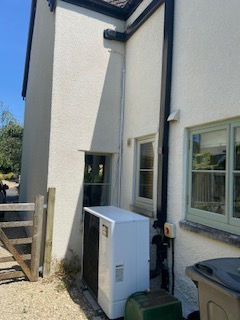
Our Home
We live in a stone cottage that is around 120 years old, with thick solid walls. Extensions built in the late 20th and early 21st centuries used modern insulating materials, so the house is a mixture of traditional and more modern construction.
Hot water and central heating were originally provided by an oil-fired combi boiler, located outside the house on a concrete hardstanding. Inside, there was an empty airing cupboard that had once housed a hot water cylinder before becoming redundant when the combi boiler replaced an older conventional oil boiler.
The central heating system consisted of ten single-panel radiators of various sizes and ages. By the time we began considering a replacement, the combi boiler was ten years old and no longer qualified for the servicing company's unlimited annual call-out package. Components had already begun to fail occasionally, so we expected maintenance costs to rise.
We also had a 500-litre metal oil tank in the garden, around 20 metres from the house and 50 metres from the road. Although oil deliveries were straightforward, checking the oil level involved dipping the tank with a long cane because the optical level indicator had failed shortly after installation. Between that inconvenience and the unpredictable price of heating oil, the idea of moving away from oil became increasingly attractive.
Would a Heat Pump Be Possible?
We first became interested in heat pumps after seeing an invitation in our local newspaper to a talk on the subject. We were impressed enough to ask the company that hosted the event to carry out a feasibility survey.
The survey suggested that a retrofit might indeed be possible, so the next step was a detailed technical assessment. This looked at room volumes, wall and window insulation, radiator sizes, and their locations throughout the house.
Because heat pumps operate at lower flow temperatures than oil boilers, they generally require larger radiators to produce the same room temperatures. The survey concluded that several of our existing radiators would need replacing with larger ones.
There was never any guarantee that replacing our oil boiler with a heat pump would reduce our heating bills. For us, however, the key question was whether we could improve energy efficiency without breaking the bank.
The installation represented a significant capital investment. At the time, the project qualified for the Government's Renewable Heat Incentive (RHI), which reimbursed a substantial proportion of the installation cost through quarterly payments over seven years. (The RHI has since been replaced by the Boiler Upgrade Scheme.)
The Installation

The company recommended installing a Mitsubishi Ecodan air source heat pump to provide both hot water and central heating.
Initially, the technical survey suggested that a single 11kW unit would not provide sufficient heating, meaning two units would be required.
However, we had already planned to replace our remaining three single-glazed windows with double glazing. Once this improvement was factored into the calculations, a single 11kW unit proved sufficient.
Conveniently, the ideal location for the heat pump was exactly where the oil boiler had stood. It sat on the existing concrete base in an unobtrusive corner of the house, close to where the mains water supply enters the property. In effect, a slightly longer white metal box replaced the old green one. The company removed the oil boiler and installed the heat pump within a matter of hours.
The flow and return pipework, together with the electrical cabling, was neatly routed up the outside wall, into the loft, and down into the airing cupboard.
Inside the house, the work included:
Installing a hot water cylinder, pressure gauges and electronic control unit in the airing cupboard.
Installing a small reservoir in the loft.
Replacing six radiators with larger double-panel models.
Relocating a seventh radiator to another room where its size was more appropriate.
Living with the Heat Pump
We have not regretted replacing our oil boiler with an air source heat pump and have been very pleased with its performance.
It provides reliable hot water and keeps the house comfortably warm. We don't like an overheated house, so we set the thermostat to maintain a daytime temperature of around 19°C. During winter evenings, however, we still enjoy lighting our log burner when we're sitting in one room for long periods, just as we did before the retrofit.
As expected, our electricity bill has increased. Given the fluctuations in both electricity and heating oil prices, it has proved difficult to determine whether the change has resulted in overall annual cost savings.
The only minor inconvenience is that we no longer have instant hot water at the kitchen tap, which is the furthest from the hot water cylinder. Our previous combi boiler delivered hot water immediately. Now we simply collect the water that runs before it heats up and use it in the garden, so very little is wasted.
An unexpected bonus came after removing the oil tank. We adapted the hardstanding where it had stood and built ourselves a summer house.
Financial Support
Today, homeowners replacing fossil fuel heating systems with heat pumps may be eligible for support through the Government's Boiler Upgrade Scheme, which currently offers grants of up to £7,500.
The Government's recent Warmer Homes Plan has also proposed grants for air-to-air heat pumps, heat batteries and biomass boilers.
Further information is available on GOV.UK.

